Posts

AI and Natural Language Processing Offer New Opportunities for Early Diagnosis of Aging-Related Diseases

Image
Artificial intelligence (AI) could help improve the early detection of Alzheimer's disease (AD), according to a study by researchers at Drexel University. The study found that OpenAI's GPT-3 AI model could recognize early stages of dementia using spontaneous speech with almost 80% accuracy.  GPT-3, also known as the third generation of OpenAI's General Pretrained Transformer, is an artificial intelligence model that uses a deep learning algorithm to process and analyze large amounts of data. One of GPT-3's key strengths is its ability to perform "zero-data learning," which means it can understand text that would normally require external knowledge that has not been provided.  The researchers used algorithms to identify cues such as hesitation, grammatical and pronunciation errors, and forgetting word meanings. Such features are often used to determine whether patients should undergo a thorough check-up. The researchers trained the model using a large dataset e...

The Role of Antifragility in Healthy Aging

Image
Aging is a complex and multifaceted process that is influenced by both genetic and environmental factors. One theory that has gained significant attention in recent years is the concept of "inflammaging," which suggests that low-grade, chronic, systemic inflammation may be a major risk factor for the development of age-related diseases and death. However, studies on long-lived individuals, particularly centenarians, suggest that healthy aging may also be associated with the ability to upregulate anti-inflammatory responses and remodel key metabolic pathways in response to stressors.  The concept of antifragility, which refers to the ability of complex systems to improve their performance in response to high stress, may also be relevant in understanding the aging process. Resilience and antifragility are similar concepts with some differences. Resilience refers to a set of protective and salutogenic, neurobiological as well as psychosocial and spiritual factors and processes ...

Advanced Age is associated with the risk of post-booster COVID-19 death

Image
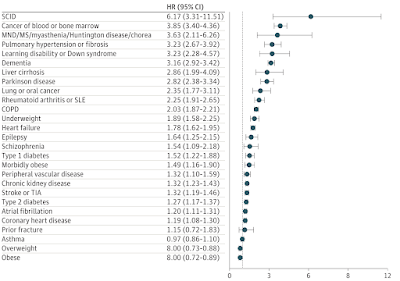
Age was found to be the most important characteristic associated with the risk of post-booster COVID-19 death  (panel A)  with an HR of 31.3 (95% CI, 26.1-37.6) for an 80-year-old individual compared with a 50-year-old.   Most of the risk groups were associated with an increased HR of post booster breakthrough death, except for congenital heart disease, asthma, and prior fracture. We note that asthma was identified as a risk factor after two doses, while age was not - likely because antibody response studies were focusing on younger cohorts.   This study population included those aged 18 to 100 years living in England who had completed both doses of their primary vaccination schedule and had received their mRNA booster 14 days or more prior to December 31, 2021. REFERENCES Nafilyan V, Ward IL, Robertson C, Sheikh A, National Core Studies—Immunology Breakthrough Consortium. Evaluation of Risk Factors for Postbooster Omicron COVID-19 Deaths in England....